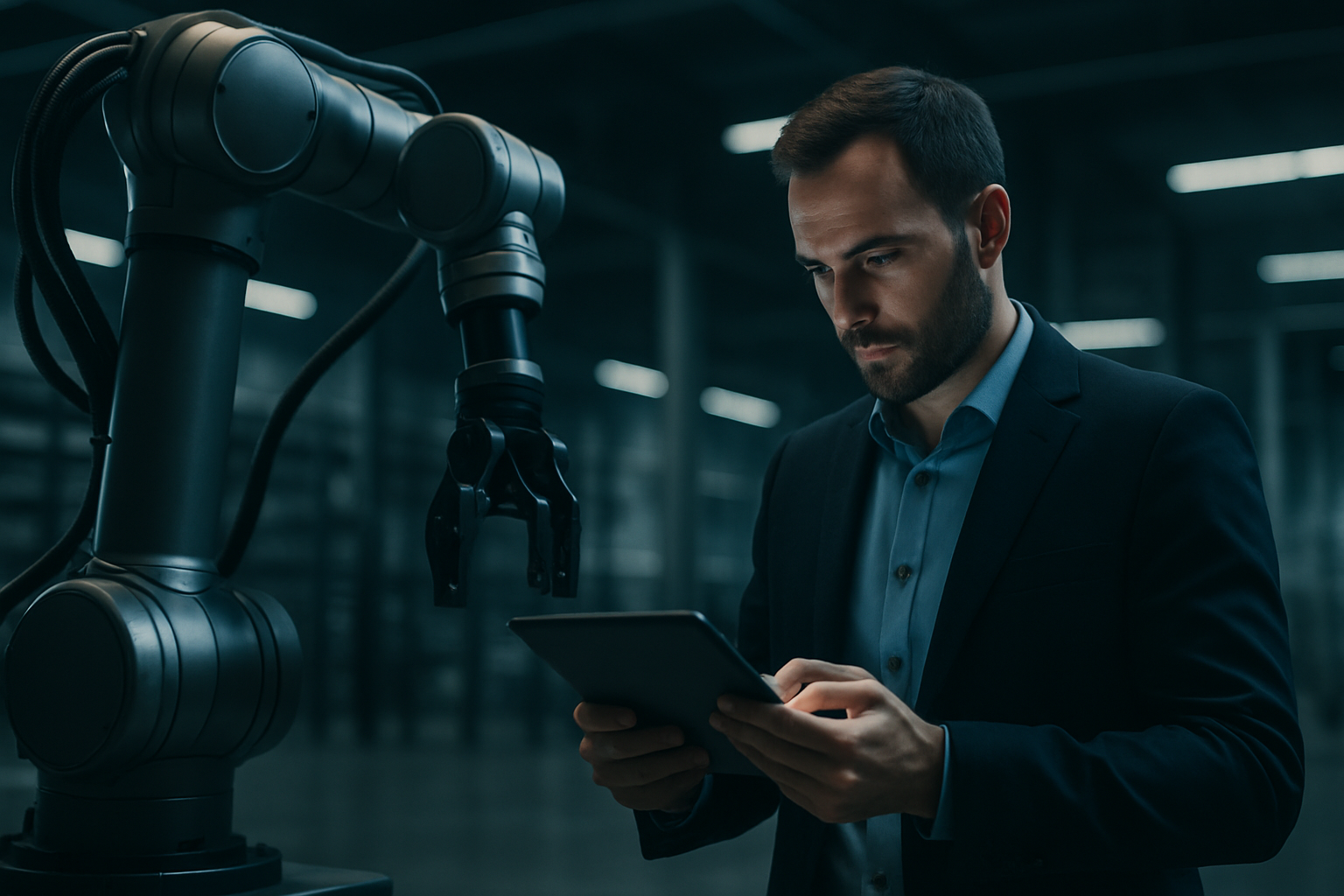
Why Physical AI Is Back on the Radar
Physical AI means combining sensing, decision-making, and motion so machines interact with the real world: robotic arms on factory lines, mobile robots in warehouses, delivery drones, or service robots in hotels. Unlike purely software AI, physical AI must cope with messy environments, hardware limits, and safety requirements.
This post explains in plain language why physical AI is resurfacing now, where it matters for businesses, and how to approach pilots without getting lost in buzz.
What we mean by "physical AI"
- Sensors: cameras, LIDAR, force sensors, proximity sensors.
- Perception and planning: models that turn sensor data into decisions (where to move, what to pick up, how to avoid people).
- Actuation: motors, grippers, wheels, arms that carry out actions.
- Software stack: real-time controllers, fleet managers, integration with business systems.
Physical AI ties these parts together so a system can sense something and reliably act on it in the real world.
Why this topic is resurfacing now
Several practical changes have lowered the barriers that kept physical AI expensive or fragile in the past:
- Better perception models: Modern vision and sensor-fusion models are more robust at recognizing objects, positions, and people in varied lighting and clutter.
- Cheap compute at the edge: Small, power-efficient accelerators make local inference feasible without sending everything to the cloud.
- Modular hardware and software: Standardized ROS (Robot Operating System) components, more off-the-shelf grippers and mobile bases, and containerized software make integration quicker.
- Falling sensor costs: LIDAR, depth cameras, and IMUs are cheaper and smaller than before.
- More mature systems integration: Companies have gained experience linking robots into ERPs, WMS (warehouse management systems), and MES (manufacturing execution systems).
- Labor pressures and economics: Tight labor markets and rising expectations for speed/accuracy make automation payback periods shorter for many operators.
- Simulation and digital twins: Better simulation tools let teams validate behaviors before deploying hardware to reduce surprises.
These factors add up: the hardware is cheaper, the software is more capable, and the integration tools are stronger. That’s why projects that failed or looked impractical five years ago are viable now.

Practical business applications today
- Warehousing and fulfillment: Mobile robots for moving goods, robotic arms for sorting or palletizing.
- Repetitive inspection: Visual inspection with robots reduces human error and scales quality checks.
- Last-mile and on-site service: Drones or compact delivery robots for campus environments.
- Manufacturing augmentation: Cobots (collaborative robots) that work alongside humans to increase throughput.
- Facilities and hospitality: Autonomous cleaning or reception robots for predictable, bounded tasks.
These are not universal fixes. Physical AI often replaces specific manual steps rather than entire workflows.
When to consider a pilot
Run a pilot if you have:
- A repetitive, well-defined task with measurable outputs (throughput, error rate, time).
- A constrained environment or one that can be made predictable (fixed bin sizes, consistent lighting, marked lanes).
- Ability to collect baseline metrics and measure improvements.
- A small, cross-functional team: operations lead, systems integrator, IT, and a safety/HR contact.
Avoid pilots when the task is highly variable, requires complex judgment, or when organizational processes can’t be changed to suit automation.

How to run a practical pilot (checklist)
- Define the metric you care about (items/hour, errors/day, cost per pick).
- Start with a single, limited area — a single aisle, one machine, one service route.
- Use simulation first to test edge cases and workflow timing.
- Plan integration points: how will the robot get tasks, report status, and hand off to human systems?
- Include maintenance and spare parts in the budget.
- Run the pilot long enough to observe variability (different shifts, lighting, traffic patterns).
- Measure hard outcomes and operational observations (downtime causes, unexpected interactions with humans).
Integration and operational tips
- Treat robots as production equipment: schedule maintenance, track MTTR (mean time to repair), and assign ownership.
- Keep software interfaces simple: REST APIs, message queues, or a standard middleware like ROS can reduce surprises.
- Focus on data flows: sensor logs and event traces are invaluable for troubleshooting and incremental improvements.
- Train staff early: people who share space with robots need clear signals, procedures, and a way to escalate issues.
Risks and trade-offs
- Hidden costs: installation, floor markings, network upgrades, and maintenance contracts can add up.
- Safety and regulations: ensure compliance with local rules, and adopt conservative safety margins in open spaces.
- Over-automation: automating a brittle or poorly understood process may magnify problems instead of solving them.
- Lock-in: proprietary platforms can make future changes harder and more expensive.
Short history and a practical lesson
Robotics has gone through cycles: large, expensive industrial systems; then niche service robots; now a broader wave because components and software have matured. The recurring lesson: start small, measure, and design for maintenance. Technology improves, but operational discipline determines success.
Conclusion
Physical AI is rising again for practical reasons: cheaper sensors and compute, stronger perception models, better integration tools, and economic pressure to automate routine physical work. It’s not a wholesale replacement for human judgment, but it can remove repetitive tasks, improve reliability, and change how teams allocate human effort.
Practical takeaway: if you manage an operation with predictable, repetitive physical tasks, assess one small pilot focused on a single metric, budget for maintenance and integration, and treat the system as production equipment from day one.
