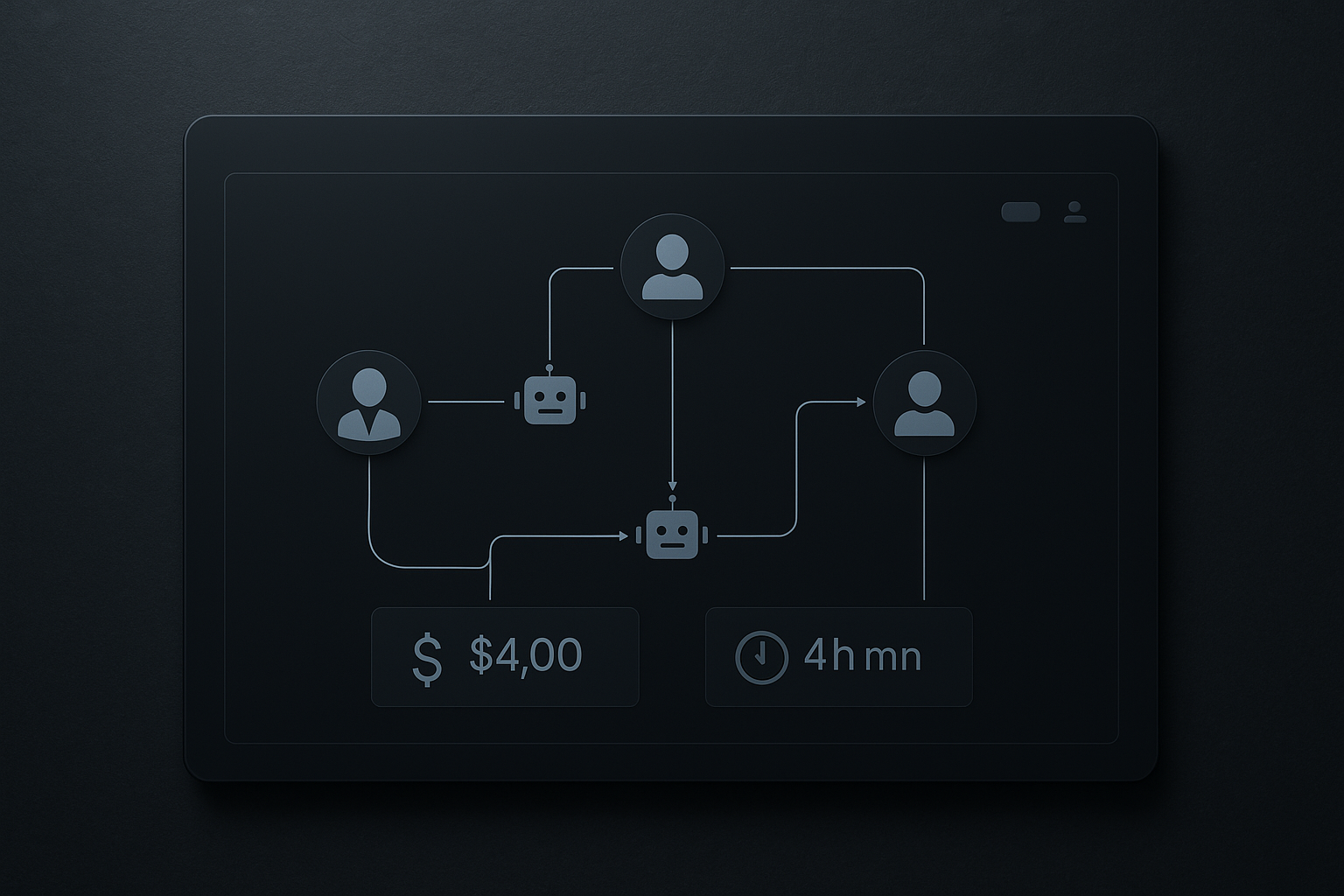
The New Software Buyer Wants Outcomes Not Seats
Software procurement has changed. Buyers used to evaluate features and count licenses. Now they ask: what measurable outcome does this produce for my team? Answering that requires more than a feature list — it requires agentic workflows and operational design that make outcomes predictable, auditable, and shareable.
This post explains how to move from seat-based thinking to outcome-based systems without reinventing how your organization actually works. Practical examples focus on quoting, order entry, intake, dashboards, handoffs, review queues, permissions, and audit trails.
What's changed in the market
- Buyers want predictable impact, not raw capabilities. They want fewer surprises on invoices and clearer links between spend and results.
- Risk tolerance is lower. Executives prefer deals where vendors share risk or where payments map to delivered value.
- Adoption expectations have shifted: software must produce usable outcomes quickly, or it gets turned off.
These changes push vendors and internal product teams to design workflows that surface value, limit risk, and make results measurable.
What we mean by "agentic workflows"
Agentic workflows are systems where automation (agents) performs tasks or recommendations within a guarded workflow. Key properties:
- Agents act on behalf of users but do not operate unchecked. They propose, execute, or monitor actions.
- Humans remain in the loop for exceptions, approvals, or high-risk decisions.
- The system records who did what and why (audit trails) and surfaces confidence and provenance for agent actions.
This approach is not about replacing workers; it's about turning repeated work into reliable systems that achieve outcomes.
Why agentic workflows enable outcome pricing
Outcome-based pricing requires predictable, auditable links between software actions and business results. Agentic workflows provide that because:
- They reduce variability: agents follow rules and templates for common cases (e.g., standard quotes or order entries).
- They expose decision points and confidence levels, so risk can be scoped and insured.
- They create logs and metrics tying actions to results — the raw material for outcome measurement.
When you can show that your system reliably improves a KPI (conversion, time-to-order, error rate), buyers are likelier to accept pricing tied to that KPI.
A practical pattern: Intake → Agent → Review Queue → Handoff
Use this repeatable pattern to convert manual work into measurable outcomes.
- Intake: capture structured inputs (lead details, product, constraints). Keep the form minimal; collect only what drives the outcome.
- Agent: generate a draft action (quote, order, recommendation) and include a confidence score and rationale.
- Review queue: route drafts to a human approver when confidence is low or when approvals are required. Show diffs and provenance, not just final text.
- Handoff: once approved, execute the action (send quote, create order) and emit an immutable event with metadata.
Benefits:
- Fewer approvals for simple cases (agents handle 60–90% of routine work in many systems when configured well).
- Clear escalation paths for edge cases.
- Audit trails for every automated and human action.

Design details that make buyers comfortable paying for outcomes
- Permissions and roles: define who can approve, who can override, and which actions require two-step review.
- Review queues that prioritize risk: auto-approve low-dollar items; human-review high-value exceptions.
- Explainability: surface agent rationale and relevant source data so reviewers can quickly validate decisions.
- Immutable events: store decisions and their inputs so auditors and customers can trace the result.
- SLAs and guardrails: set acceptable error rates, remediation flows, and rollback paths. Outcome pricing usually ties to SLA thresholds.
Example: quoting and order entry
Imagine a vendor offering outcome pricing for faster quote turnaround and higher win rates.
- Baseline: quotes created manually; average turnaround 3 days; win rate 20%.
- Agentic workflow: agent drafts quotes using templated pricing rules and historical deal data; low-risk quotes auto-approve and issue within hours.
- Measure: median turnaround drops to 6 hours; win rate increases to 25%; disputed quotes fall by half.
- Pricing model: a subscription with a baseline fee plus a bonus tied to incremental closed revenue or per-quote success fee.
Because every automated step is logged and reviewed when necessary, the vendor can credibly bill against the incremental outcome.

Building trust: audits, metrics, and pilot programs
Buyers won't accept outcome pricing without trust. Build it iteratively:
- Start with pilots that focus on a single, high-impact outcome (e.g., quotes per rep, order error rate).
- Instrument thoroughly: capture inputs, agent outputs, decisions, timestamps, and human overrides.
- Show dashboards that map actions to outcomes and break down contribution by agent vs. human.
- Offer a clear remediation policy for mistakes and a mechanism for buyers to revoke or pause automation.
This transparency reduces perceived vendor risk and accelerates adoption.
Selling and packaging outcome offers
Practical packaging options:
- Baseline subscription + outcome bonus: predictable revenue plus upside tied to agreed KPIs.
- Consumption plus guarantee: charge per operation (per-quote, per-order) with a performance guarantee (e.g., percent of quotes delivered within SLA).
- Success fee: no charge until specific measurable gains are reached — good for greenfield adoption but risky if your ops can't deliver.
Terms to negotiate up front:
- Which outcomes and how they are measured.
- How to attribute changes to the software vs. other factors.
- Data access and audit rights.
- Error-handling and dispute resolution.
Implementation checklist for product and ops teams
- Identify a single workflow where agentic automation will drive a measurable KPI.
- Map every decision point and who owns it (agent, approver, system).
- Build structured intake forms and dataset connectors so agents have consistent inputs.
- Implement review queues, role-based permissions, and immutable event logging.
- Create dashboards that connect agent actions to the chosen outcome and show attribution.
- Run a pilot with clear success criteria and a timeline for scaling.
A short case sketch: turnaround time on custom quotes
Situation: sales ops spends hours generating custom quotes, causing lost deals.
Approach:
- Instrument current process and measure median turnaround and reasons for delay.
- Build an agent that fills quote templates using price lists, volume discounts, and negotiation history.
- Configure auto-approve for quotes under a dollar threshold and low complexity.
- Route complex quotes into a prioritized review queue with a 2-hour SLA.
- Track outcome: percent of quotes delivered within SLA, win rate change, and revenue moved through the system.
If results are consistent, offer customers a pricing option where they pay a fee tied to improved turnaround and lift in win rate.
When to avoid outcome pricing
Outcome models aren't a fit when:
- Outcomes are influenced mainly by variables outside your control (market demand, competitor actions).
- You can't instrument the workflow reliably.
- The vendor lacks operational control to influence the outcome.
In those cases, focus first on operational improvements and traceability, then revisit outcome offers.
Conclusion
The buyer's mindset has shifted from seats to outcomes. Agentic workflows — automation that acts inside well-designed, auditable human workflows — make it realistic to promise and measure those outcomes. The result is better alignment between vendor incentives and buyer value, faster adoption, and clearer paths to scaling automation.
Practical takeaway: pick one high-impact workflow, instrument it, add guarded agentic automation with review and audit trails, measure the outcome, and use those measurements to build an outcome-linked pricing pilot.
